
Battery internal resistance is a "hard indicator" reflecting the true health of battery cells, unaffected by BMS data tampering. Mastering the scientific principles, tool selection, standard ranges, and practical steps of internal resistance testing can penetrate false health levels, 100% judge the cell quality of used iPhone batteries, and avoid purchasing aged or damaged low-quality batteries.
Scientific Principles and Core Significance of Internal Resistance
(Why It's a "Hard Indicator")
1.Definition and Physical Nature of Internal Resistance
Battery internal resistance refers to the total resistance encountered by current passing through the battery, measured in milliohms (mΩ). It consists of two parts:
① Ohmic internal resistance: Including the resistance of electrode materials, electrolyte, and separators, it is the inherent resistance of the battery itself;
② Polarization internal resistance: Generated by polarization phenomena in electrochemical reactions, including electrochemical polarization and concentration polarization, directly related to cell activity.
For used iPhone batteries, the core significance of internal resistance lies in its direct reflection of the cell's aging degree and internal state—when cells age and activity decreases, the structure of electrode materials is damaged, the conductivity of the electrolyte decreases, leading to an increase in ohmic internal resistance; at the same time, polarization internal resistance also rises due to the reduction of active materials, ultimately resulting in a significant increase in total internal resistance. More importantly, internal resistance is a physical property of the cell, unaffected by BMS data tampering. Even if the merchant modifies the health level and cycle count, internal resistance will truly expose the cell's state.
2.Correlation Logic Between Internal Resistance and Battery Performance (Data Support)
The size of internal resistance directly affects the battery's charging and discharging efficiency, battery life performance, and safety stability, showing a significant negative correlation:
Charging and discharging efficiency: The larger the internal resistance, the more energy loss converted into heat during charging, and the slower the charging speed; during discharging, the voltage drops faster, and the available capacity decreases. Experimental data shows: A battery with 30mΩ internal resistance can be charged to 60% in 30 minutes; a battery of the same model with 80mΩ internal resistance can only be charged to 35% in 30 minutes.
Battery life performance: For every 10mΩ increase in internal resistance, the actual battery life decreases by approximately 8%-10%. For example, if the internal resistance of an iPhone 13 battery increases from 40mΩ to 60mΩ, the light-use battery life will drop from 7 hours to about 5.6 hours.
Safety and stability: Batteries with excessively large internal resistance have severe voltage fluctuations during discharge, which may cause the phone to restart frequently or freeze; at the same time, the heating problem associated with increased internal resistance will accelerate cell aging, and even trigger bulging or leakage risks.
3.Aging Law of Internal Resistance in Used iPhone Batteries
Combined with Apple's official internal resistance standard range for iPhone batteries and actual data from the second-hand market, a clear aging law can be summarized:
Brand-new battery: Internal resistance 25-35mΩ, optimal cell activity, highest charging and discharging efficiency;
Mild aging (health 85%-100%): Internal resistance 35-50mΩ, battery life close to brand-new, no obvious attenuation;
Moderate aging (health 70%-85%): Internal resistance 50-70mΩ, battery life decreased by 15%-30%, requiring attention to maintenance;
Severe aging (health <70%): Internal resistance 70-100mΩ, severe battery life attenuation, with potential safety hazards;
Scrap-level battery: Internal resistance >100mΩ, cells are severely damaged, power supply abnormalities may occur at any time, not recommended for use.
Tool Selection and Usage Methods for Internal Resistance Testing
(Scenario-Adapted)
1.Professional Internal Resistance Tester (First Choice for Accurate Testing)
Operation Steps:
① Preparation: Turn on the tester, select the "lithium battery internal resistance test" mode, and calibrate the instrument (some models require calibration with standard resistors);
② Battery Connection: For disassembly testing, directly touch the positive and negative probes of the tester to the positive and negative poles of the battery terminal (red for positive, black for negative), ensuring good contact without looseness; for non-disassembly testing, it can be detected through the positive and negative contacts of the mobile phone's charging port (requires a dedicated adapter);
③ Data Reading: After stable contact, the tester will display the internal resistance value and voltage value. Read continuously 3 times and take the average value (to avoid errors caused by poor single contact);
④ Result Judgment: Compare with the internal resistance standard of the corresponding model to judge the battery aging degree.
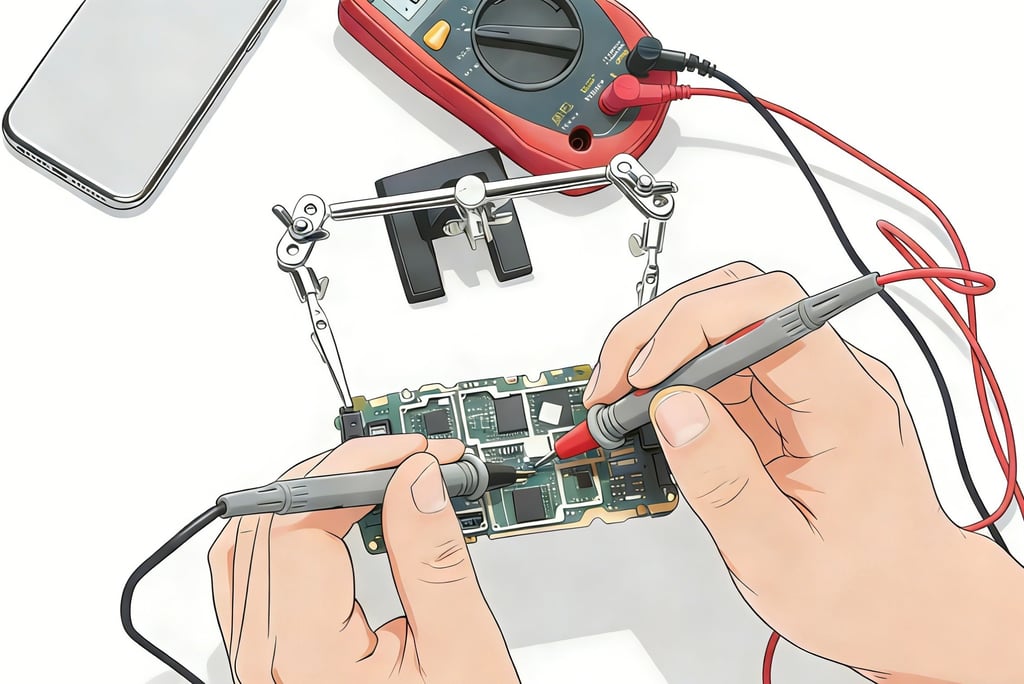
Notes: Testing should be performed when the battery is at room temperature (16℃-22℃); high or low temperatures will affect the internal resistance value; avoid testing during charging, as data will be distorted due to charging current interference.
2.Portable Mini Tester (First Choice for Personal Users)
Operation Steps:
① Tool Preparation: Purchase a test clip suitable for the iPhone battery (distinguish battery interfaces of different iPhone models);
② Connection Method: Clamp the positive and negative poles of the test clip to the positive and negative terminals of the battery, ensuring the clip is fully in contact with the metal terminal (no oxidation or stains);
③ Data Viewing: The tester screen will directly display the internal resistance value, no complex operation required, suitable for beginners to test quickly;
④ Error Correction: Due to the slightly lower precision of portable testers (±1mΩ), it is recommended to test 2-3 more times. If the value fluctuates within 5mΩ, take the median as a reference.
3.Mobile APP Auxiliary Test (Preliminary Screening)
Operation Steps:
① Download and Install: Search for "Battery Monitor" in the App Store (jailbreak required or partial functions paid), or install iMazing on the computer;
② Data Reading: Open the APP, authorize access to battery data, wait for the system to read the voltage and current change data in the BMS chip, and the APP will estimate the internal resistance through algorithms;
③ Result Reference: The internal resistance estimated by the APP has a large error (±10mΩ), which can only be used for preliminary screening—if the estimated internal resistance is >80mΩ, the battery is likely severely aged; if <50mΩ, further precise testing with professional tools is recommended.
4.Multimeter Emergency Test (When No Dedicated Tool is Available)
Operation Steps:
① Mode Selection: Set the multimeter to the "DC voltage range" (DCV 20V range);
② Voltage Test: Touch the probes to the positive and negative poles of the battery to read the voltage in the fully charged state (should be 4.15V-4.2V normally);
③ Load Test: Connect a 5Ω resistor as a load, measure the voltage again, and record the voltage drop (ΔV);
④ Internal Resistance Calculation: Calculate the internal resistance according to Ohm's law R=ΔV/I (I=V/R load). For example, the fully charged voltage is 4.2V, the voltage after loading is 3.9V, ΔV=0.3V, I=4.2V/5Ω=0.84A, internal resistance R=0.3V/0.84A≈357mΩ (this method has large errors, only for reference).
Internal Resistance Standards and Identification Practices for Different Models
(Precise Pitfall Avoidance)
Different iPhone models have different battery capacities and cell designs, resulting in differences in internal resistance standards. Combined with common models in the second-hand market, precise identification standards and practical cases are sorted out:
1.Internal Resistance Standard Comparison Table for Mainstream Models
Battery specifications vary across different iPhone series. The iPhone 14/15 Pro Series has a battery capacity of 3200-4400mAh, with a brand-new internal resistance range of 28-38mΩ. For used units, the acceptable upper limit of internal resistance is 60mΩ, and the replacement threshold is 80mΩ.
The iPhone 11-13 Series features a battery capacity of 2227-3687mAh, a brand-new internal resistance range of 30-40mΩ, an acceptable upper limit of 65mΩ for used batteries, and a replacement threshold of 85mΩ.
The iPhone XR/XS Series has a battery capacity of 2658-3174mAh, a brand-new internal resistance range of 32-42mΩ, an acceptable upper limit of 70mΩ for use, and a replacement threshold of 90mΩ.
For the iPhone X/8 Series and earlier models, the battery capacity is 1821-2716mAh, with a brand-new internal resistance range of 35-45mΩ. The acceptable upper limit for used batteries is 75mΩ, and the replacement threshold is 95mΩ.
2.Practical Steps for Offline Purchase Identification (Core Process)
① Query the internal resistance standard of the target model in advance: Confirm the acceptable upper limit of internal resistance according to the target model (e.g., for purchasing an iPhone 12, the acceptable internal resistance is ≤65mΩ);
② Request the merchant to disassemble and test: If the merchant refuses to disassemble, the battery is likely problematic, so abandon the purchase directly;
③ On-site testing and data recording: Use a portable internal resistance tester to test continuously 3 times, take the average value, and record the battery voltage (should be ≥4.15V when fully charged);
④ Cross-verification: Combine with battery health and cycle count. If the internal resistance is 60mΩ but the health shows 95% with 100 cycles, the data is contradictory, and BMS data tampering may be involved—proceed with caution;
⑤ Auxiliary battery life test: If the internal resistance is within the acceptable range, perform a 30-minute video battery life test. The power consumption should be ≤15%; otherwise, there may be false power or other faults.
3.Online Purchase Identification Skills (No Disassembly Condition)
① Request the merchant to provide an internal resistance test video: The video should clearly show the tester model, battery code, testing process, and values to avoid the merchant using fake videos for fraud;
② Verify data correlation: Ask the merchant to provide health screenshots and cycle count screenshots, and cross-verify with internal resistance values. It is credible only if it conforms to the aging law (e.g., internal resistance 55mΩ, health should be between 80%-90%);
③ Choose a store that supports disassembly inspection: After receiving the goods, test according to the offline practical steps. If the internal resistance exceeds the agreed standard, apply for a refund.


Cause Analysis and Treatment Plans for Abnormal Internal Resistance
(Avoid Blind Replacement)
After detecting abnormal internal resistance, there is no need to replace the battery immediately. First, analyze the specific cause and take targeted measures to save costs:
1.Common Causes of High Internal Resistance
Natural cell aging: The most common cause. Excessive cycle count or long storage time leads to attenuation of active materials;
Battery bulging/leakage: Damage to the internal structure of the cell leads to a sharp increase in internal resistance, usually accompanied by deformation of the battery appearance;
Improper charging: Long-term use of fast charging or non-certified accessories accelerates cell aging and increases internal resistance;
High-temperature damage: Long-term use in high-temperature environments leads to electrolyte decomposition and increased internal resistance;
BMS chip failure: In rare cases, abnormalities in the BMS chip can cause distortion of internal resistance test data, requiring recalibration.
Natural cell aging (internal resistance 50-70mΩ)
This can be addressed by optimizing charging habits (shallow charge and discharge, disabling fast charging) and power consumption control (turning off 5G and background refresh). These measures slow the rate of internal resistance increase and improve battery life by 10%-15%. It is suitable for scenarios where battery health is between 70%-85% with no safety hazards.
Natural cell aging (internal resistance >70mΩ)
It is recommended to replace the battery with an original disassembled unit or a branded third-party battery. After replacement, the internal resistance can be restored to 35-50mΩ, and battery life returns to normal. This solution applies when battery health is <70% with severe battery life attenuation.
Battery bulging/leakage
Stop using the device immediately, replace it with a new battery, and check whether the mobile phone motherboard is corroded. This completely eliminates safety hazards. This approach is for cases where the battery is deformed or leaking liquid.
Increased internal resistance due to improper charging
Replace certified charging accessories, switch to slow charging, and perform capacity calibration once a month. This stabilizes the internal resistance and prevents rapid rises. It is suitable when internal resistance is <60mΩ with no other faults.
BMS chip failure
Go to a professional repair shop to calibrate the BMS chip or flash the system to reset it. After treatment, the internal resistance data returns to normal with an error of <5mΩ. This applies when there are severe fluctuations in internal resistance values that are inconsistent with battery health.
2.Cause-Specific Treatment Plans
3.Safety Warnings for Abnormal Internal Resistance
If the following situations occur, the battery has serious safety hazards—stop using it immediately and replace it:
Internal resistance >90mΩ, accompanied by frequent mobile phone restarts and severe heating during charging;
Bulging battery appearance, elastic when pressed, or rust and leakage at the terminals;
Internal resistance suddenly increases by more than 20mΩ within 1 month, with abnormal aging speed.
